
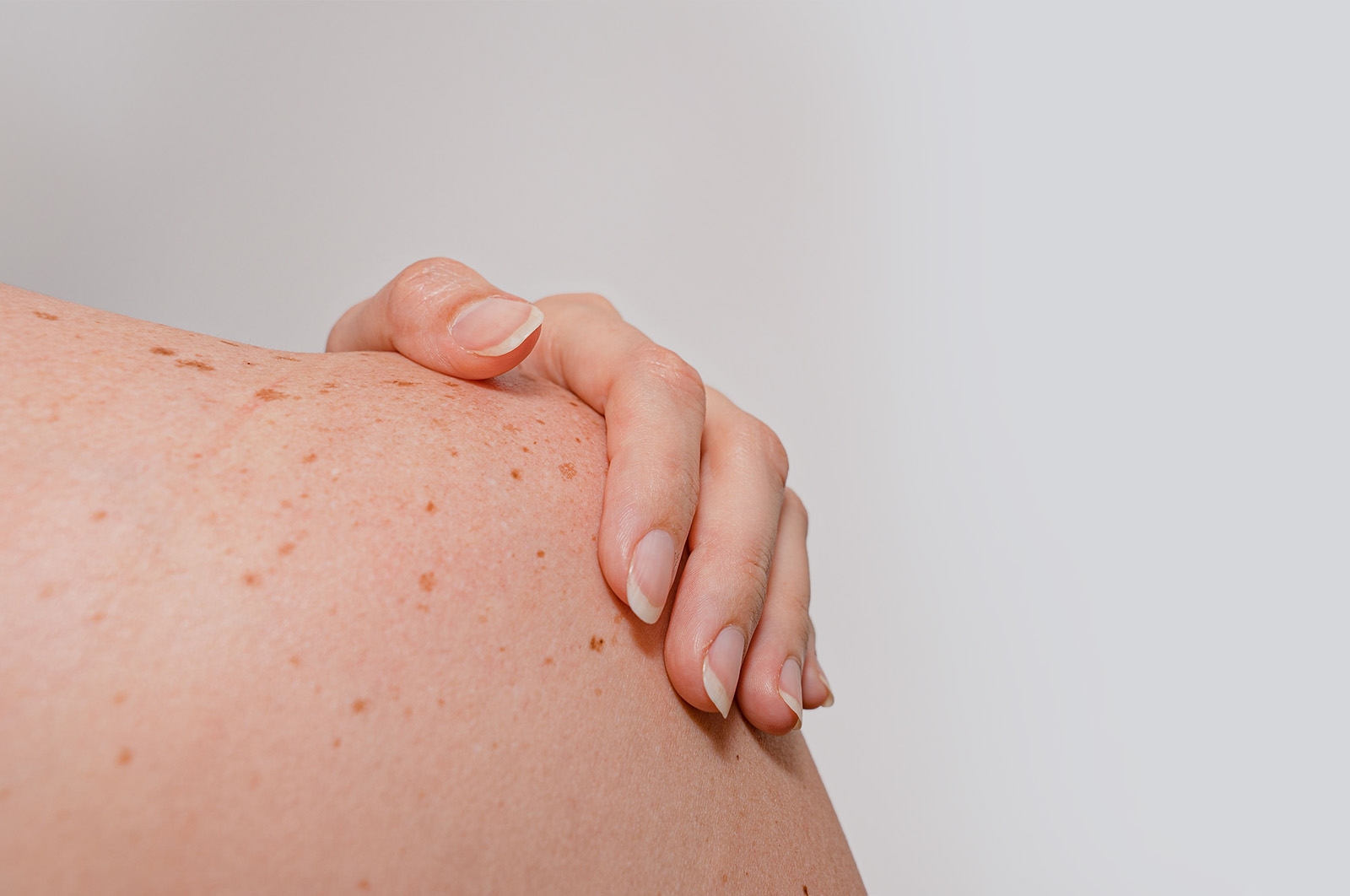
What you need to know
Moles may look like simple brown spots or freckles, but their shape, size, and colour can tell you a lot about your skin health. While most moles are harmless, some can be early signs of skin cancer. That’s why it’s important to know your skin and to keep an eye on any changes.
Don’t rely on online pictures – use the SkinVision app to instantly check your skin spots for signs of skin cancer.
First of all, what exactly is a mole?
A mole (also called a nevus) is a group of pigment-producing cells called melanocytes. These cells give your skin its colour. Moles can appear at birth or develop later in life – especially from sun exposure.
- Most adults have 10-40 moles.
- People with lighter skin usually have more moles.
- Moles can change or increase as we age.
The average number of moles for adults is between 10 and 40. Moles can even come and go with hormonal changes such as pregnancy or puberty. Most people develop more moles on their skin naturally with age and sun exposure, and most of the time these are harmless. However, we need to conduct skin checks regularly (recommended monthly, especially if there is a family history of skin cancer, or at least every three months) to check whether they have changed.
A quick guide to common mole types
Moles come in any shape and size. Below is a quick overview of the most common mole types, based on the World Health Organization (WHO) classification, and what they might mean for your skin. For more in-depth information, visit DermNet®, a free and trusted resource on skin conditions. No matter the skin type, regular skin checks are important, especially if you have many moles or notice changes in size, shape or colour.
Common acquired nevi
Common moles are small, usually less than 6 mm, with smooth, regular edges and an even color. They appear both in childhood and adulthood and can be influenced by sun exposure (mostly), genetics, and other factors. Most common moles are harmless, but some can change over time and rarely may develop into skin cancer, so it’s good to keep an eye on them.
Common moles can form in different layers of the skin:
- Junctional nevi: located where the top and deeper layers of the skin meet.
- Dermal nevi: found deeper in the skin.
- Compound nevi: a mix of both layers.
Simple lentigo
Simple lentigines are small, usually less than 6 mm, with smooth, well-defined edges and an even light- to dark-brown color. They often appear in sun-exposed areas, such as the face, neck, hands, forearms. These spots may start in childhood, increase in number through mid-life, and sometimes fade as people get older. They are most common in people with lighter skin and are influenced by both sun exposure and genetics. They are generally harmless and have a very low risk of developing into melanoma.
Lentiginous nevi
Lentiginous nevi are small, flat or slightly raised spots made up of clusters of pigment-producing cells in the same area. They are also common in people with lighter skin and are influenced by both sun exposure and genetics. They are generally harmless and have a very low risk of developing into melanoma.
Atypical nevi
Atypical nevi are larger moles (usually 5 mm or more) that can have uneven or blurry borders, mixed colors, and sometimes a slightly raised “fried-egg” appearance. They can appear anywhere on the body but are most often found on the back. They typically develop during adolescence or early adulthood and are influenced by sun exposure, fair skin type, and genetics. Most atypical moles are harmless, but having several of them or having very atypical ones can increase the risk of melanoma. This makes regular skin checks especially important.
Congenital melanocytic nevi
Congenital melanocytic nevi are moles present at birth or appearing in the first year of life. They can occur anywhere on the skin and are usually brown to black, round or oval, well-defined, and uniform. Some may have thicker hair or a slightly textured surface.
Size categories in adults:
- Small: <15 mm. Occur in about 1% of newborns.
- Intermediate: 15–200 mm.
- Giant: >200 mm (rare; may extend deeper or involve the nervous system).
Most of these nevi are harmless, but lifetime melanoma risk varies:
- Small/intermediate: ~1–2%.
- Large with satellite lesions or CNS involvement: up to 10–15%.
Halo Nevi
Halo nevi are moles that develop a round, lighter-colored “halo” of skin around them. They are most common on the trunk, less frequent on the head, and rare on the limbs. They often appear in teenagers and young adults, sometimes as several spots at once, and the mole may fade over time. Halo nevi are caused by the immune system targeting pigment cells in the mole. They can also be seen in people with vitiligo or after treatments that stimulate the immune system, such as melanoma therapy. Most halo nevi are completely benign. However, when a halo nevus first appears in adulthood, there is a small risk (about 1%) of an underlying melanoma, so checking it with a professional is recommended.
Spot check: how to judge your mole
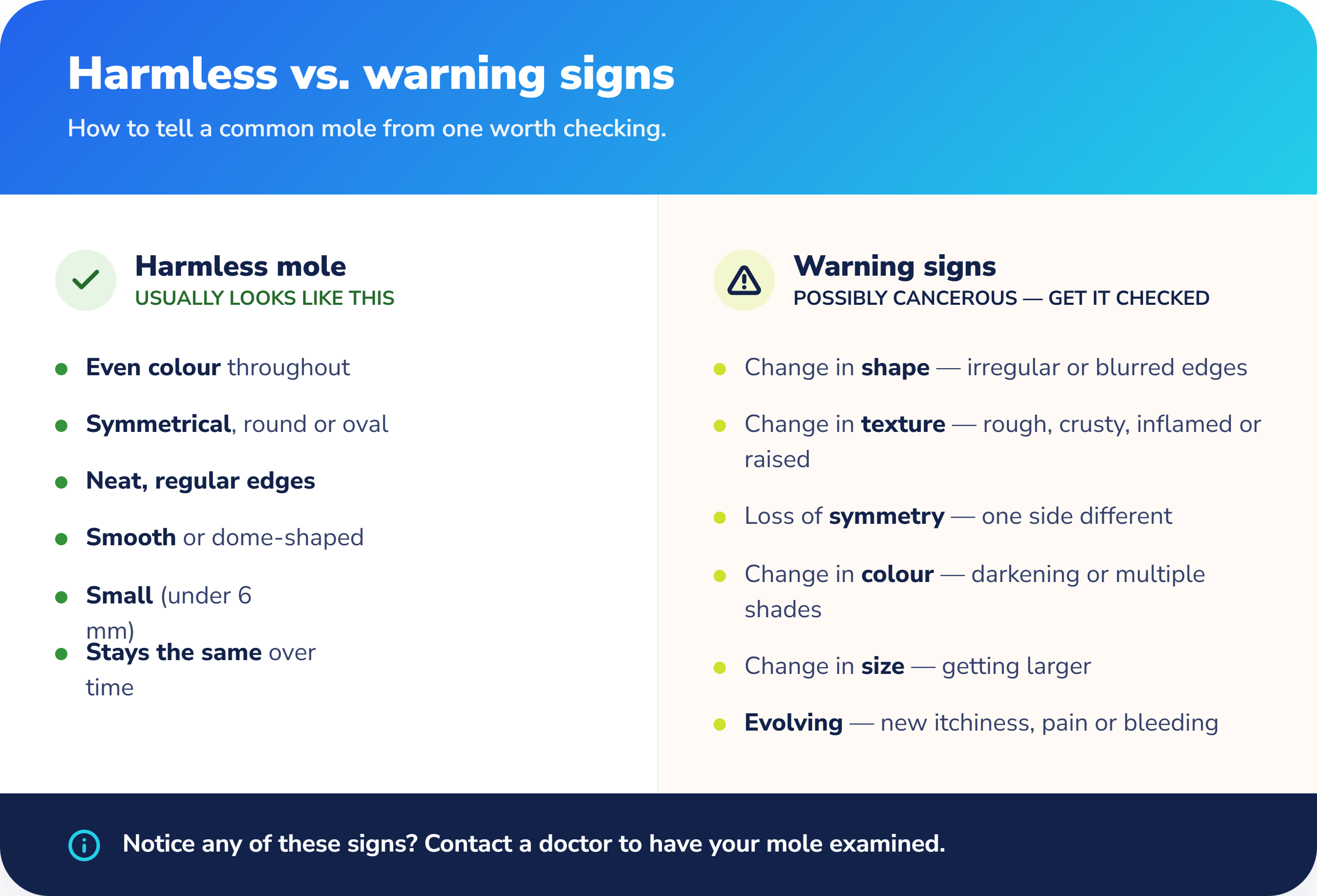
Check your moles regularly to note possible changes. If a mole has gone through recent changes in colour, size, shape elevation or is bleeding, itching or crusting – bring it to the attention of a health professional.
Self-exam basics: Monthly skin self-checks are essential. Start by knowing your baseline – what your skin and moles normally look like – so you can recognize changes. Use a full-length and a hand mirror to inspect yourself from head to toe. Don’t forget hidden spots: scalp, between fingers and toes, under the nails, soles, genitals, and under breasts.
SkinVision supplements your self skin exam and enables you to check skin spots for signs of cancer within 30 seconds, with algorithm accuracy comparable to a specialist dermatologist. The app provides clear next-step advice for high-risk spots and lets you store photos to track changes over time.
Red spots
What can cause red spots on skin?
Red spots on skin can appear for a wide variety of reasons and can be the sign of very mild conditions or a serious skin disease. The severity of symptoms and their duration can help to determine the underlying cause of complaints. Some of the most common conditions that have symptoms of red spots on skin include:
- Rashes.
- Chicken pox.
- Measles.
- Psoriasis.
- Bowen’s Disease (a very early form of skin cancer which presents itself as red patches that are often itchy).
- Rosacea.
- Basal Skin Cancers (most commonly found on the face, scalp, ears, hands, shoulders, and back).
In order to minimize the risk of suffering from a serious medical condition such as skin cancer, it is important to recognize any changes in your normal skin condition. Although red spots on skin can be a symptom of a non-threatening condition such as an allergy, they may also be linked to early signs of skin cancer and so a swift medical assessment can be key to effective treatment.
Are there other symptoms to be aware of?
Red spots on the skin may be accompanied by other symptoms such as raised lumps, itching, pain, heat, bleeding and broken skin. These symptoms are all reflective of conditions such as an allergy to washing powder through to key signs of skin cancer or melanoma. With that in mind, early medical assessment can ensure the most suitable treatment. Any lumps, skin discoloration, nonhealing wounds or ongoing skin complaints should be assessed by a medical professional as a matter of priority.
Should I see a doctor if I notice changes to my skin?
Understanding your own body is key to maintaining healthy skin as this will help you to readily recognize any changes that may pose a risk to you. It is important for a doctor to assess any red spots on the skin that you may have as well as any accompanying symptoms. This will ensure that any underlying conditions or more serious complaints are quickly diagnosed and treated.
White spots
What can cause white spots on skin?
Reassuringly, white spots on skin are rarely an indicator of skin cancer. Rather, the symptoms are predominantly associated with the condition of Vitiligo. This is a non-life threatening condition, that primarily affects cosmetic views, rather than a sufferer’s health. In assessing any skin conditions with a focus on determining the risk of skin cancer, it is important that individuals can recognise any changes in their normal skin. Although white spots on skin are unlikely to be caused by cancer, other changes such as red spots, enlarged moles, wounds that won’t heal and itching lumps may be an indicator of skin cancer.
Should I see a doctor if I notice changes to my skin?
White spots on skin may not cause pain, discomfort or health complications, but it is important to have any long-term changes in skin assessed by your doctor. Many people who suffer from conditions that are linked to this symptom have a family history of related conditions and as such, diagnosis is relatively simple. Rest assured that these symptoms are highly unlikely to be the result of a serious illness, but early assessment can lead to effective treatment and minimised cosmetic impact.
It is relevant to be sure that the spots on your skin are white, rather than pink. White spots are a sign of pigmentation loss, whereas pink spots can be a symptom of more serious conditions.
In order to protect yourself from the risks of skin cancer and to maintain healthy skin, it is vital to understand your normal skin type and condition to ensure that you can readily recognise any changes or damage. The sooner any complaints are recognised and assessed by a doctor, the lower the risk of serious complaints such as skin cancer or melanoma. Any damage to the skin or changes to the normal condition of your skin that has not passed within 4 weeks, should be referred to a doctor as a matter of urgency.